The Execution Trap: Why Being Too Good at Your Job Can Limit Your Growth
How understanding the business impact of your work can position you for strategic responsibility

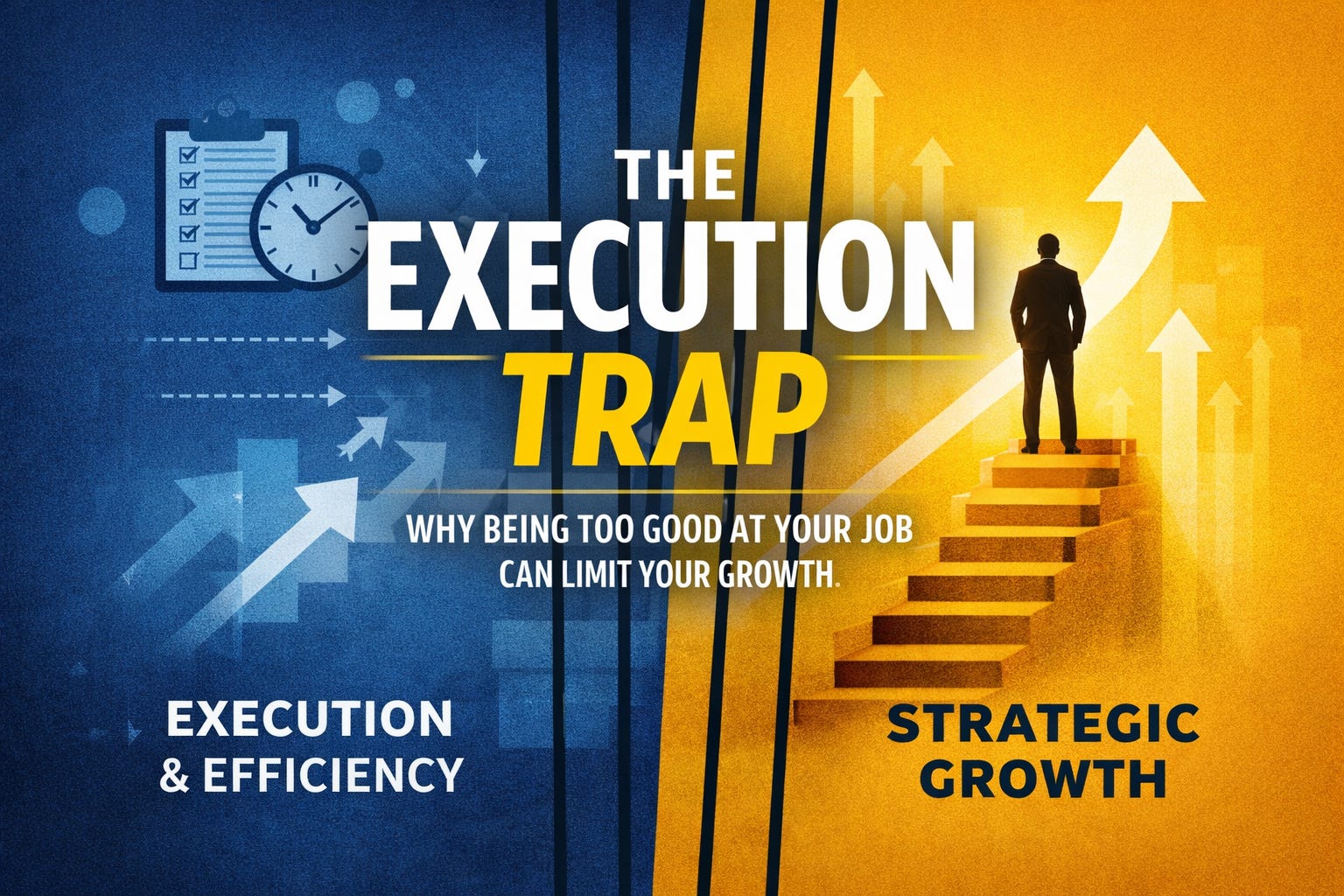
For many of us moving from the early stages of our careers into that in-between phase, not quite entry-level anymore but not yet in what would be considered a “strategic” role, there comes a point where we begin to ask ourselves:
I have all this experience now, so how do I actually get to the strategic side of things?
You’ve spent the last few years learning how to execute. You know how to navigate your systems now. You understand your processes. You’ve supported projects, coordinated initiatives, handled deadlines, followed up with stakeholders, and delivered on what was asked of you. On paper, you’re no longer the “newbie.”
But internally, something feels unchanged.
You’re still not quite where you thought you would be by now.
And that’s when the questions start to surface.
Do I actually have the skill set required to move into a more strategic role? Am I missing some kind of knowledge or competency? Is there something I’m supposed to learn before I can be trusted with that level of responsibility?
Sometimes, we convince ourselves that what we need is simply more time. One more year. One more project. One more opportunity to prove that we’re capable.
Especially as early-career professionals, many of us have been given the impression, sometimes directly and sometimes indirectly, that working harder will eventually grant us access to more strategic opportunities. That if we consistently deliver, take on more tasks, stay late when needed, and become reliable executors of the work assigned to us, we will naturally be invited into higher-level conversations or decision-making spaces.
However, that is often a facade.
When we consistently volunteer to take on more tasks and become highly reliable executors of the work assigned to us, we unintentionally reinforce a very specific perception of our role within the team.
We begin to be seen not just as contributors, but as executors.
While that reliability is valuable, it can also create an invisible boundary around how others envision our capabilities.
In many cases, when someone becomes exceptionally good at execution, it becomes difficult for leadership to picture them operating beyond it. The person who always gets things done becomes the person who is depended on to keep getting things done. Over time, they are trusted with more responsibility, but of the same nature and magnitude.
More coordination.
More tracking.
More implementation.
More delivery.
Because they are known for being proficient in execution, they are often overlooked when opportunities arise that require interpretation, analysis, or decision-making. Not necessarily because they lack the potential to operate at that level, but because they have consistently been relied upon to operate elsewhere.
Inadvertently, the very behaviors we believe will grant us access to more strategic work can position us as indispensable executors of operational work instead.
From what I’ve observed through conversations with mentors and in my own experience, leaders often begin to involve individuals in higher-level conversations not based on title, but based on their demonstrated sense of ownership over the work they’ve been entrusted with.
Ownership not just in the sense of completing assigned tasks, but in being able to take responsibility for a body of work in its entirety. This includes leading a project or responsibility to the best of one’s ability, navigating its challenges, and ensuring that it moves forward in a way that aligns with broader team or organizational goals.
It also involves being able to connect the work being done to its impact on the business.
In many cases, individuals who are able to take ownership of their responsibilities, implement new processes, assist with integrations, identify workflow inefficiencies, or improve the way work gets done are often seen differently.
Not necessarily because their role has changed, but because they have demonstrated the capacity to think beyond execution and connect their work to business impact.
Strategy, at its core, is about being able to connect your day-to-day responsibilities to broader business outcomes. It’s about understanding the impact of what you’re doing on the organization and how it contributes to improving performance, protecting the business from risk, reducing inefficiencies, or even saving costs.
In other words, strategy is not separate from execution.
It is the way you interpret execution in the context of business impact.
For a long time, I approached my work the way most early-career professionals are trained to. Execution became the goal. Completing what was assigned became the measure of success.
While there is nothing inherently wrong with execution, organizations rely on it. Remaining in a purely executional mindset can unintentionally position someone as excellent at doing tasks but disconnected from the broader business outcomes those tasks are meant to influence.
The shift didn’t happen when my responsibilities changed. It happened when my questions did.
Context became a very important part of how I began approaching my work.
I no longer wanted to simply action responsibilities because they appeared in my job description or were assigned to me. I wanted to understand why I was being asked to do them in the first place.
Why are we doing this?
What is this meant to influence?
What is the impact of what I’m doing on the business?
I started asking these questions because I wanted to understand the value that my work was creating within the organization, not just whether I had completed it. I became more interested in the purpose behind the task than the task itself.
I stopped asking:
Was this completed?
And started asking:
What does this completion or lack of it mean for the business?
Somewhere along the way, I stopped functioning solely as a doer and started showing up as an analyzer of the work I was being asked to do. I became more interested in what this process was trying to improve, what risk this task helped mitigate, what organizational goal this work supported, or what decision leadership might now be able to make if this metric improved.
I began to realize that completing the work is operational.
But understanding the impact of the work is what makes your contribution strategic.
There is little value in waiting around to be given a strategic opportunity.
Because at the end of the day, we are all capable of thinking strategically. We simply need to uncover that part of ourselves by understanding the essence of the work we’re doing and looking beyond the task itself.
Ultimately, it always comes back to the business.
How is the work we’re doing improving performance?
Protecting operations?
Saving time?
Reducing cost?
Enabling better decisions?
When we begin to approach our responsibilities with that level of context and intention, we move from simply executing tasks to interpreting their value.
So don’t wait around to be invited into strategy.
Start by understanding the impact of the work you’re already doing.
Because the moment you begin to think about your work in terms of its impact on the business, you are no longer just executing it. You are interpreting it.
And that is what begins to qualify you for strategic responsibility.